
 By
By A gentle, practical guide for new mothers written from the eyes of a Lactation Professional (CLP & IYCF Specialist)
Becoming a new mother is beautiful but breastfeeding can feel overwhelming in the beginning. Many mothers tell me:
“I don’t know if my baby is latching correctly.”
“Am I producing enough milk?”
“Why is my baby feeding so often?”
If you’re feeling the same way, please know this: breastfeeding is natural, but it is also a learned skill for both you and your baby. As a PharmD, Certified Lactation Professional (CLP), and IYCF specialist, I guide new mothers every day, and the challenges you feel today are completely normal.
This guide will gently walk you through everything you need to know to begin breastfeeding with confidence.
🌼 The First Hour After Birth: The Golden Hour
The first hour after birth is incredibly powerful for breastfeeding. This time is often called:
👉 The Golden Hour
During this hour:
- Place your baby skin-to-skin on your chest
- Allow your baby to explore and self-latch
- Your body releases oxytocin, which helps the placenta deliver and boosts milk flow
- Your newborn receives colostrum, the thick, yellow, nutrient-rich first milk
The gold standard recommendation is to begin breastfeeding within the first hour of birth, whenever medically possible.
🌼 Understanding Colostrum: Your Baby’s First Immunity
Colostrum is often called “liquid gold”, and for good reason:
- It’s rich in antibodies
- Protects against infections
- Helps baby’s gut mature
- Perfectly matches the size of baby’s tiny stomach
In the first days, your breasts produce small amounts a few milliliters at a time.
👉 This is completely normal.
👉 Your baby’s stomach is only the size of a marble.
🌼 The First Week: What Is Normal?
The first week can feel confusing. Here’s a clear, simple timeline:
🌱 Days 1–3
- Milk is mostly colostrum
- Small quantities (drops to teaspoons)
- Baby may feed very frequently
👉 This does NOT mean low supply.
👉 This is how your baby stimulates your milk to come in.
🌷 Days 3–5
- Milk transitions from colostrum to mature milk
- Breasts may feel fuller, warmer, or heavier
- Baby’s sucking becomes more rhythmic
🌼 Days 5–7
- Milk volume increases
- Baby settles into a feeding pattern
- Wet diapers increase
🌼 How Often Should Your Baby Feed?
Newborns need:
👉 8–12 feeds in 24 hours
👉 Feeding every 2–3 hours, sometimes more
Babies feed frequently because:
- Their stomachs are tiny
- Breast milk digests quickly
- Frequent feeding helps build your supply
This is normal, not a sign of low milk.
🌼 How to Know Your Baby Is Getting Enough Milk
Mothers often worry unnecessarily. Watch for these signs instead:
✔ Enough wet diapers
- Day 1 → 1 wet diaper
- Day 2 → 2 wet diapers
- Day 3 → 3 wet diapers
- Day 4 onwards → 6+ wet diapers/day
✔ Baby seems satisfied after feeding
✔ Swallowing sounds during feeding
✔ Baby regains birth weight by day 10–14
✔ Steady weight gain after 2 weeks
If these are present → your supply is adequate.
🌼 Good Latch: The Heart of Successful Breastfeeding
A deep, comfortable latch ensures:
- Baby gets enough milk
- You avoid nipple pain
- Milk flows efficiently
A good latch looks like:
- Baby’s mouth wide open
- Lips flanged outward
- More areola visible above baby’s mouth than below
- Baby’s chin touching the breast
- You hear soft swallowing
If it hurts badly, the latch needs adjustment not your nipples.
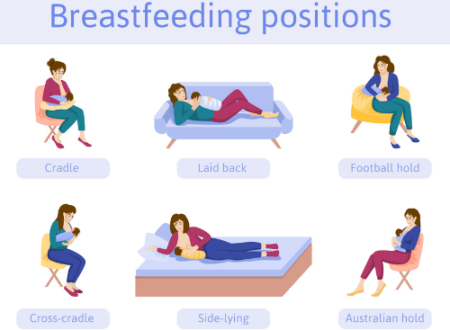
🌼 Positions to Try for Breastfeeding
Every mother-baby pair is different. Try these:
- Cradle Hold
- Cross-Cradle Hold (best for beginners)
- Football Hold (good after C-section)
- Side-Lying Position (great for night feeds)
Finding the right position can change everything.
🌼 Cluster Feeding: A Completely Normal Phase
Many mothers panic when their baby suddenly wants to feed every hour.
This is called cluster feeding.
It usually happens:
- In the evenings
- During growth spurts
- When baby wants comfort
It does NOT mean low supply.
It is your baby’s way of increasing your milk production.
🌼 Things That Can Temporarily Affect Milk Supply
- Long gaps between feeds
- Stress & lack of sleep
- Dehydration
- Poor latch
- Supplementing frequently without pumping
All of these can be corrected with guidance.
🌼 Tips for a Smooth Breastfeeding Start
- Do lots of skin-to-skin contact
- Feed on demand, not on schedule
- Avoid timing feeds
- Avoid bottles/pacifiers in the early weeks if possible
- Take care of your hydration & meals
- Rest whenever you can
And most importantly don’t hesitate to ask for help.
🌼 When to Seek Lactation Support
Reach out if you experience:
- Severe nipple pain
- Baby unable to latch
- Very sleepy baby missing feeds
- Poor weight gain
- Feeling overwhelmed or unsure
A lactation professional can correct simple issues early before they become bigger problems.
🌼 A Gentle Note from Me to You
Mama, breastfeeding is a journey not a test you need to pass.
It’s okay if it feels difficult in the beginning.
It’s okay to ask for help.
You and your baby are learning together, step by step.
Your body is designed for this, and with the right support, breastfeeding becomes one of the most beautiful bonds you will ever experience.
Disclaimer
The information on this website is for educational purposes only and is not a substitute for professional medical advice. Always consult a qualified healthcare provider for personal medical concerns.