 By
By Written from the perspective of a Lactation Professional (CLP & IYCF Specialist)
Breastfeeding should feel comfortable, natural, and pain-free. But for many new mothers, the early days can feel confusing:
“How should I hold my baby?”
“Why does breastfeeding hurt?”
“Is my baby latching correctly?”
Here’s the reassuring truth:
👉 Most breastfeeding problems improve instantly with the right position.
A good position → better latch → efficient milk transfer → more comfort for you and more milk for baby.
As a Certified Lactation Professional, these are the exact positions I teach mothers in the first hours and weeks after birth. Let’s walk through them together gently, step by step.
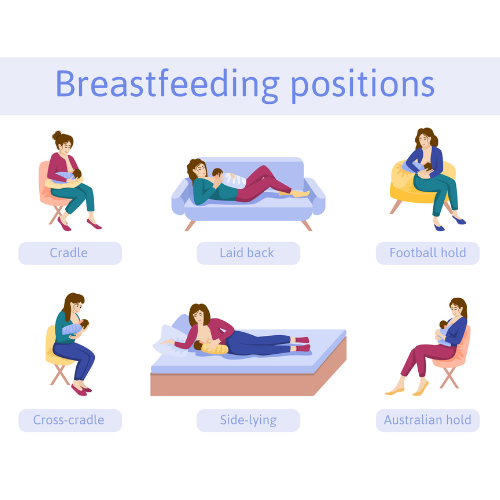
🌼 1. Cross-Cradle Hold (BEST FOR BEGINNERS)

This is the position I recommend most often to new mothers because it gives excellent control over baby’s head and helps achieve a deep latch.
How to do it:
- Hold baby across your body, opposite to the feeding breast (If feeding from left breast → support baby with right arm)
- Support baby’s neck and shoulders with your hand
- Use your other hand to support your breast
- Bring baby to the breast, not breast to baby
Why it works:
- Helps guide baby’s head gently
- Ensures proper alignment (ear–shoulder–hip in one line)
- Promotes a deep, comfortable latch
Best for:
✔ First-time moms
✔ Babies struggling to latch
✔ Small or preterm babies
🌼 2. Cradle Hold (Common & Comfortable)

This is the classic, natural position many mothers settle into with practice.
How to do it:
- Baby lies across your lap
- Baby’s head rests in the crook of your arm
- Baby’s chest facing your chest
Why it works:
- Comfortable once breastfeeding is established
- Relaxed and natural position
Best for:
✔ Older newborns
✔ Confident latchers
Not ideal if:
- You’re struggling with latch
- Baby needs more head control
🌼 3. Football or Clutch Hold

(Excellent after C-section or for twins)
In this position, baby is tucked under your arm like holding a “football”.
How to do it:
- Sit upright with good back support
- Place baby at your side, under your arm
- Support baby’s neck with your hand
- Baby’s body rests along your forearm
- Bring baby’s mouth to the breast
Why it works:
- Keeps baby away from your incision (C-section safe!)
- You can see baby’s latch clearly
- Perfect for mothers with larger breasts
Best for:
✔ C-section recovery
✔ Twins
✔ Premature babies
✔ Babies with weak latch
🌼 4. Side-Lying Position (Great for Night Feeds)

This position allows you to rest while feeding your baby safely.
How to do it:
- Lie on your side
- Baby lies facing you, tummy to tummy
- Use your hand to guide baby to latch
- Support your head with a pillow
Why it works:
- Perfect for tired mothers
- Reduces strain on back and arms
- Comfortable for nighttime feedings
Best for:
✔ Night feeds
✔ Recovery days
✔ Mothers with perineal soreness after birth
🌼 5. Laid-Back or Biological Nurturing Position

(Beautiful for natural latch reflex)
This position encourages your baby’s innate instincts.
How to do it:
- Recline comfortably (45° angle)
- Place baby tummy-down on your chest
- Baby’s body rests naturally against you
- Gravity helps baby stay in position
Why it works:
- Encourages baby’s natural rooting & crawling reflex
- Perfect for deep latch
- Very relaxing and natural
Best for:
✔ Overactive letdown
✔ Babies who tend to gulp or choke on milk
✔ Mothers wanting pain-free latch
🌼 6. Koala / Upright Position

(Excellent for reflux or babies with ear infections)
Baby sits upright and feeds while straddling your thigh or hip.
How to do it:
- Sit comfortably
- Baby sits upright facing you
- Baby’s head rests near your breast
- Support baby’s back and neck
Why it works:
- Gravity helps milk flow gently
- Good for babies who cough, choke, or have reflux
- Comfortable for older babies
Best for:
✔ Reflux
✔ Overactive letdown
✔ Bigger babies (3+ months)
🌼 Signs of a Good Breastfeeding Position
No matter which position you choose, watch for these signs:
✔ Baby’s belly faces your belly
✔ Baby’s chin touches the breast
✔ Baby’s nose is free
✔ Baby’s neck isn’t twisted
✔ You hear soft swallowing
✔ No pain during feeding (initial tugging is normal)
✔ Baby’s mouth is open wide
If feeding hurts after the first 10–15 seconds →
👉 reposition and re-latch.
🌼 Common Positioning Mistakes (Avoid These)
❌ Leaning forward toward baby
→ puts pressure on your back
❌ Baby’s body not aligned (head twisted)
→ causes shallow latch
❌ Baby too far away
→ leads to nipple pain
❌ Supporting baby’s head too tightly
→ baby can’t tilt back properly
❌ Pushing baby’s head from the back
→ causes fussiness and shallow latch
With the right position, breastfeeding becomes much easier.
🌼 As a Lactation Professional, My Gentle Advice
Remember, mama:
You don’t need to master every position.
Just choose one or two that feel safe, supported, and comfortable.
A good position is one where:
- Your shoulders relax
- Your baby’s body feels secure
- Feeding feels peaceful
- There is no sharp pain
You and your baby are learning together.
🌼 When to Reach Out for Help
Seek lactation support if:
- You experience persistent nipple pain
- Baby can’t stay latched
- Baby seems unfulfilled after long feeds
- You hear clicking sounds
- Feedings take extremely long
- You feel unsure or anxious
Getting help early can prevent long-term breastfeeding challenges.
Disclaimer
The information on this website is for educational purposes only and is not a substitute for professional medical advice. Always consult a qualified healthcare provider for personal medical concerns.