
 By
By A PharmD & Lactation Professional’s Evidence-Based Guide for Parents
Your baby is unwell. Your heart is racing. You want to help them feel better fast.
But reaching for any medicine without guidance can be more harmful than helpful.
As a PharmD and Lactation Professional, I’m here to walk you through everything you need to know about giving medicines safely to infants.
💛 Infant bodies are not just small adult bodies. They process medicines very differently.
Let’s understand this simply, clearly, and safely.
🌼 Why Infant Medicine Safety Is So Important
Babies, especially under 12 months, have:
- immature liver and kidneys (limited ability to break down drugs)
- different body water and fat composition
- underdeveloped blood-brain barrier
- higher sensitivity to drug side effects
👉 This is why dosing, formulation, and timing matter enormously in infants.
🚫 The Golden Rule: Never Self-Medicate an Infant
Before giving any medicine to your baby:
✔ Always consult your pediatrician or pharmacist
✔ Never use adult formulations for infants
✔ Never guess the dose based on what worked for an older child
✔ Never crush tablets unless specifically instructed
When in doubt don’t. Call your doctor first.
How Infant Doses Are Calculated
Infant doses are not based on age alone.
They are based on:
- Body weight (mg/kg dosing)
- Age (especially for newborns vs older infants)
- Kidney and liver maturity
- Specific condition being treated
👉 This is why your pediatrician’s prescription is personalized never share medicines between children, even siblings.
✅ Commonly Used Medicines in Infants What’s Safe?
(Always use under medical guidance with correct dosing)
🌡 Fever & Pain
- Paracetamol (Acetaminophen) — safe from birth (with correct dosing)
- Ibuprofen — only from 6 months onwards, not for younger infants
🤧 Cold & Congestion
- Saline nasal drops — safe and recommended for nasal congestion
- Steam inhalation — gentle and effective
- OTC decongestants / antihistamines — ❌ NOT recommended under 2 years
🦠 Infections
- Antibiotics — only when prescribed by a doctor
- Never self-prescribe or use leftover antibiotics
💧 Diarrhea & Dehydration
- ORS (Oral Rehydration Solution) — first line for dehydration
- Zinc supplementation — may be recommended by doctor for diarrhea in infants above 6 months
- Anti-diarrheal drugs — generally NOT recommended in infants
🤮 Vomiting
- ORS in small sips — most effective
- Medicines for vomiting in infants must only be prescribed by a doctor
🐛 Colic & Gas
- Simethicone drops — commonly used; generally considered safe
- Gripe water — not evidence-based; consult before use
⚠️ Medicines That Are NOT Safe for Infants
These are commonly misused — please avoid:
| Medicine | Why It’s Dangerous |
| Aspirin | Risk of Reye’s syndrome — never give to children |
| Adult cough syrups | Can cause breathing problems or overdose |
| Honey (as medicine) | Risk of infant botulism under 1 year |
| Herbal drops/tonics | Unstudied safety; may contain toxic compounds |
| Homeopathic teething gels | Some contain belladonna — not safe |
| Any prescription medicine without advice | Unpredictable and dangerous |
💊 Safe Dosing Tips for Parents
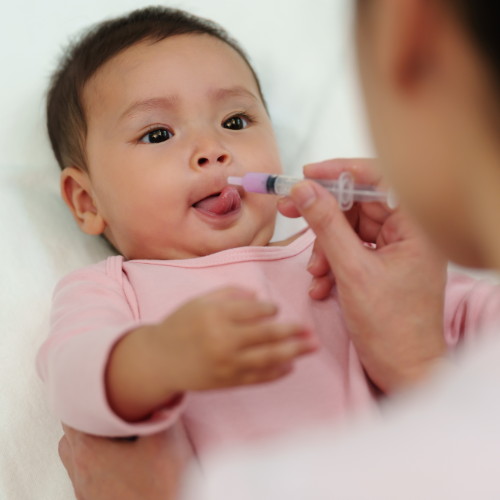
✔ Always use the measuring syringe or cup provided with the medicine
✔ Never use a kitchen spoon sizes vary and cause dosing errors
✔ Give medicines at the right interval avoid overdosing
✔ Complete the full antibiotic course even if baby seems better
✔ Store medicines as instructed (some need refrigeration)
✔ Check expiry dates before use
🧠 Common Myths About Infant Medicines
❌ “More medicine = faster recovery”
👉 Not true — overdosing is dangerous. Always follow prescribed doses.
❌ “If it’s safe for my 3-year-old, it’s safe for my baby”
👉 False — infant dosing and safety is completely different.
❌ “Natural or herbal medicines are always safe for babies”
👉 Not necessarily — many herbal products are unstudied in infants and can be harmful.
❌ “Antibiotics cure everything — including viral colds”
👉 Completely false — antibiotics work only on bacteria, not viruses. Unnecessary use causes antibiotic resistance.
❌ “Paracetamol can be given freely for any fussiness”
👉 No — give only for confirmed fever or pain, at the correct dose and interval.
🌡 When Should You Give Paracetamol?
Paracetamol is the most commonly used infant fever medicine — but use it wisely:
✔ Give only when temperature is ≥ 38°C (100.4°F)
✔ Use weight-based dosing typically 10–15 mg/kg per dose
✔ Maintain a gap of 4–6 hours between doses
✔ Do not give more than 4 doses in 24 hours
✔ Do not alternate with ibuprofen without doctor advice
👉 Low-grade fever in infants is not always harmful the body’s immune response is working.
🚨 When to See a Doctor Immediately
Do not wait or self-medicate if your infant has:
- Fever in a baby under 3 months
- Temperature above 39°C in any infant
- Difficulty breathing or fast breathing
- Severe vomiting with signs of dehydration (no tears, dry mouth, sunken fontanelle)
- Rash along with fever
- Unusual drowsiness or limpness
- Refusal to feed for more than a few feeds
- Convulsions or fits
These are medical emergencies. Reach your pediatrician or emergency care immediately.
💛 A Gentle Message to Parents
I know how frightening it is to see your baby unwell.
Every parent wants to do something to make the pain go away.
But the safest thing you can do is:
✔ Stay calm
✔ Consult your doctor or pharmacist before any medicine
✔ Trust evidence-based care over social media advice
✔ Ask questions no question is too small when it comes to your baby
Your baby deserves safe, correct, and evidence-based care. You deserve guidance you can trust.
🌐 When to Consult a PharmD / Pharmacist
Your pharmacist is a medicine safety expert. Reach out to them when:
✔ You are unsure about a medicine’s dose for your baby
✔ You want to check if two medicines can be given together
✔ You need guidance on storage or administration
✔ You want to understand what a prescribed medicine does
✨ Final Takeaway
Infant medicine safety is not complicated but it does require care, knowledge, and the right guidance.
The right medicine, at the right dose, at the right time that is what keeps your baby safe.
Never medicate without guidance. And never hesitate to ask a professional.
Disclaimer
The information on this website is for educational purposes only and is not a substitute for professional medical advice. Always consult a qualified healthcare provider for personal medical concerns.